


By Staff Reporter
Climate Change is reaching catastrophic levels with a very limited time for the world to make it stop. Part 1 of the Assessment Report #6 (AR6) of the Intergovernmental Panel on Climate Change (IPCC) released last August 2021 confirms – the planet has already warmed to an average of 1.09 degree Celsius. Countries all over the world have been experiencing its devastating impacts and we are facing even greater risks and harm in the years to come. To keep on track with fulfilling the goal of the Paris Climate Agreement to keep global temperature rise to below 1.5 degree Celsius, we need a swift, equitable and just transition out of fossil fuels. In this regard, several countries in the Global South recently initiated a Parliamentarians’ Call for a Fossil Fuel Free Future (FFFF) and are inviting their colleague legislators from all over the world to join them. The African Youth Peer Review Committee Coordinator from Zimbabwe highlighted that currently almost 200 legislators from the Global South have signed to the Call. “This comes at a time when some countries in the Global North including Germany and the United Kingdom are reverting back to using coal due to the current energy crisis globally,” he added.
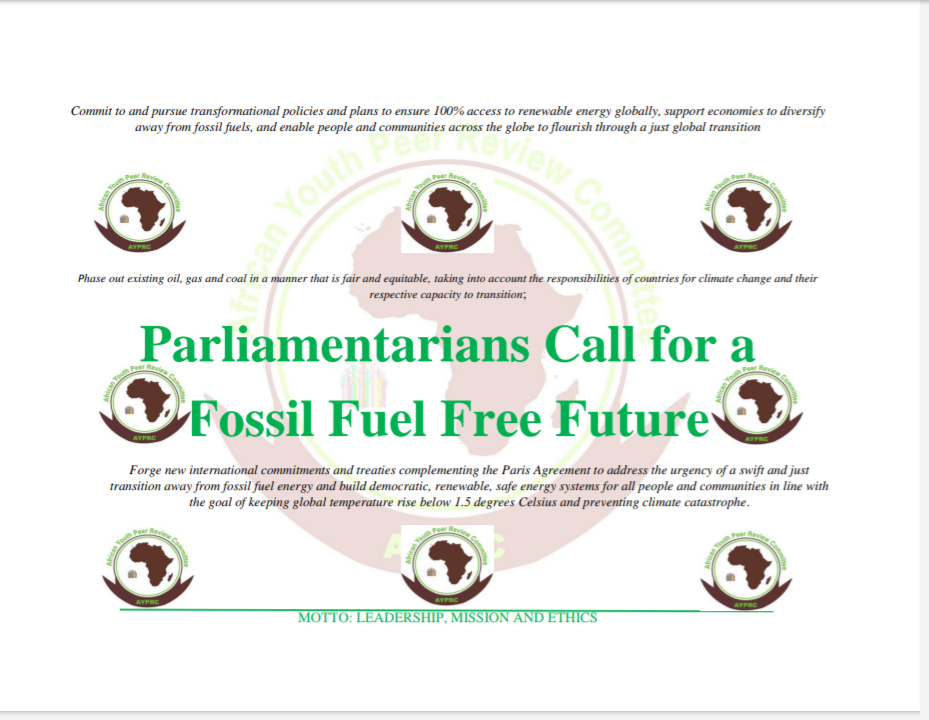
The Call is urging governments to do more and go the full distance to commit to and pursue transformational policies and plans to ensure 100% access to renewable energy globally, support economies to diversify away from fossil fuels, and enable people and communities across the globe to flourish through a just global transition. Enactment of national budgets and fiscal policies that will support this swift and just transition nationally and globally is also key to Call. The legislators connects this by calling for the timely and adequate delivery of public, additional and non-debt creating climate finance as part of the obligations of rich, industrialized countries to address climate change.
The Parliamentarians are also calling for an end to new expansion of oil, gas and coal production in line with the best available science as outlined by the Intergovernmental Panel on Climate Change and United Nations Environment Program. They highlight that existing oil, gas and coal has to be phased out in a manner that is fair and equitable, taking into account the responsibilities of countries for climate change and their respective capacity to transition. The legislators further call for the forging of new international commitments and treaties complementing the Paris Agreement to address the urgency of a swift and just transition away from fossil fuel energy and build democratic, renewable, safe energy systems for all people and communities in line with the goal of keeping global temperature rise below 1.5 degrees Celsius and preventing climate catastrophe.
 Community Climate Action Trust